Beyond the Tour: The Real Questions That Reveal Whether a Childcare Center Will Nurture Your Child or Just Watch Them
The tour always looks the same, doesn't it? Bright primary colors, a wall of toddler artwork, a director who uses the phrase "loving environment" at least four times. You nod, you smile, you sign the enrollment paperwork — and then you spend the next three weeks wondering if you made the right call.
Here's the truth: almost every childcare center in America can look good for thirty minutes. What matters is what happens on a random Tuesday at 10 a.m., when no parents are watching. And the only way to get a peek behind that curtain is to ask better questions than the ones on the standard "choosing quality childcare" handout.
Start With the One Number Nobody Volunteers
Caregiver turnover. It's the single most revealing statistic about any early childhood program, and almost no parent thinks to ask about it.
Young children build attachments through repetition and consistency. When a beloved teacher leaves every eight months, your child isn't just losing a familiar face — they're repeatedly rebuilding trust from scratch. Some turnover is inevitable in this field (wages in early childhood education remain stubbornly low across the US), but a center that keeps its staff for years is telling you something important about how it operates.
Ask directly: "How long has your current lead teacher in the infant room been here? What about the toddler room?" A confident answer is a green flag. A vague "we have great people" is worth a second visit.
Curriculum Philosophy: Listen for Buzzwords, Then Ask for Examples
Every center these days claims to be "play-based" or "developmentally appropriate" or "STEM-focused." The words themselves mean less than whether the staff can actually explain them in practice.
Instead of asking "What's your curriculum?" try this: "Walk me through what a typical morning looks like for a two-year-old here." Then listen for specifics. Do kids move between activities they choose, or does everyone do the same craft at the same time? Is there room for a child who wants to spend twenty minutes lining up toy cars, or does the schedule always win?
There's no single right philosophy — Montessori-inspired, emergent, structured pre-K readiness all have merit. What matters is that the people in the room can articulate why they do what they do. Programs that nurture development know their reasoning. Programs that are babysitting with a license deflect.
The Toddler Conflict Test
Here's a scenario worth asking about out loud: "Two kids want the same truck. One grabs it, the other bites. What happens next?"
Watch how the person answers, not just what they say. Strong programs will talk about staying calm, coaching words ("You can tell Maya: my turn"), and helping both children recover. Weaker answers focus on punishment — time-outs, loss of privileges, "we don't tolerate that here." Conflict between toddlers isn't a discipline problem; it's a developmental milestone. The staff response should sound like teaching, not policing.
This is also where ratios matter. Ask about group sizes, not just the adult-to-child ratio printed on the state licensing poster. Six toddlers with two teachers is a very different experience than ten toddlers with two teachers, even when both are technically compliant.
Five Questions to Bring on Your Next Visit
- "How do you handle a child who's having a hard morning at drop-off?" — Listen for patience and individual strategies, not one-size-fits-all rules.
- "What happens when my child gets hurt or sick?" — You want clear communication policies, not improvisation.
- "How do you share what my child did today?" — Daily updates, even brief ones, signal engagement.
- "What's your policy on screen time?" — Whatever your preference, a center should have a deliberate answer.
- "Can we visit unannounced?" — Transparent programs rarely say no.
Trust What You See, Not What You Hear
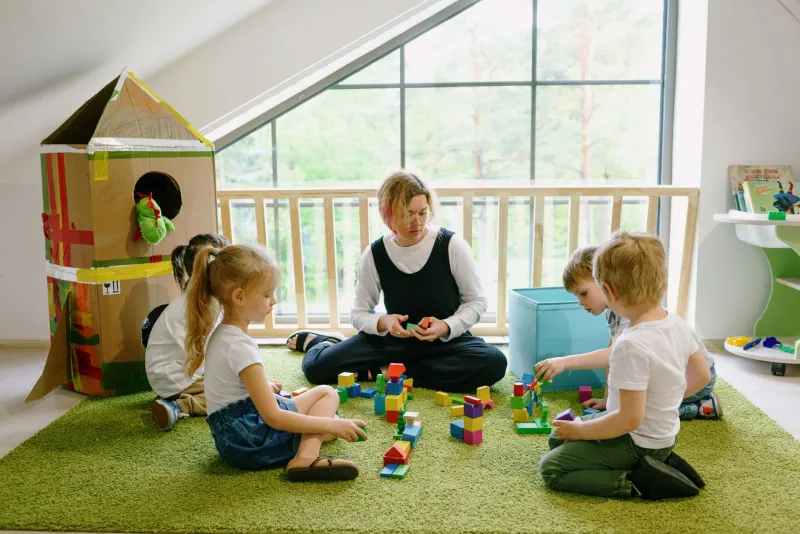
Finally, if the center allows it, visit during program hours — not nap time, not right at opening. Watch how teachers kneel down to children's eye level. Listen to whether you hear children's voices or only adult voices. Notice whether a crying child gets comfort or just a glance.
The right program will feel less like a facility and more like a second home — a place where your child is known, not just supervised. And when you find it, you'll know. Because the questions you asked won't feel like an interrogation. They'll feel like the beginning of a partnership.