Go Ahead, Let Them Make a Mess: What's Really Happening When Kids Get Their Hands Dirty
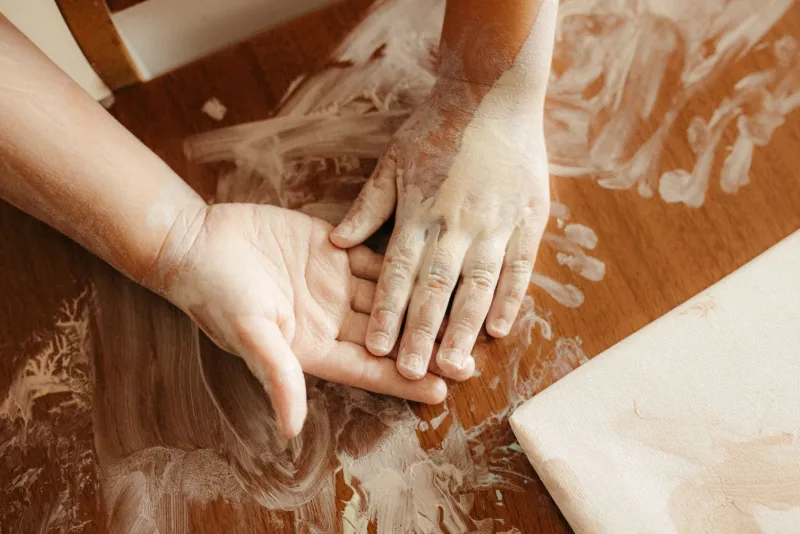
Let's be honest. When your toddler tips the entire container of kinetic sand onto the kitchen floor with the expression of someone who has just achieved something magnificent, your first instinct is not to celebrate their development. It's to reach for the broom and maybe cry a little.
We get it. Mess is exhausting, especially when you're already managing approximately forty-seven other things before 9 a.m. But before you redirect that impulse to contain every splatter and crumb, consider this: the mess might actually be the whole point.
Sensory-rich, unstructured play — the kind that involves squishing, smearing, pouring, and generally creating small-scale disasters — is doing serious developmental work. And the more we understand what's actually happening during those chaotic moments, the easier it becomes to take a breath, step back, and let it happen.
Why Toddler Brains Are Basically Wired for Mess
Young children don't learn the way adults do. They don't sit still, absorb information, and apply it later. They learn by doing — by touching, tasting, throwing, stacking, and yes, spreading finger paint across every available surface. Sensory play is the primary language of early childhood learning, and it speaks directly to the parts of the brain that are developing fastest right now.
When a two-year-old digs their hands into a bowl of cold, wet playdough, their brain is processing an enormous amount of information simultaneously: texture, temperature, resistance, smell, color, cause and effect. Every squeeze and poke sends signals racing through neural pathways, strengthening connections that support everything from language acquisition to emotional regulation.
Occupational therapists and early childhood researchers have long emphasized that sensory experiences in the early years aren't just fun — they're foundational. The tactile system (your sense of touch) is one of the first sensory systems to develop and plays a critical role in how children organize and understand their world. Kids who get regular, varied sensory input tend to have better body awareness, improved attention spans, and a stronger capacity to self-regulate. That's not a small thing.
The Skills Hiding Inside the Chaos
Here's a closer look at what's actually developing during some of the messiest activities in your toddler's repertoire:
Finger Painting
Beyond the obvious creative expression, finger painting is a fine motor workout. Moving paint across paper requires children to vary pressure, control direction, and coordinate their fingers and hands in increasingly precise ways — the same skills they'll eventually need for writing. There's also something deeply satisfying about the direct cause-and-effect relationship: push here, color appears there. That's early science, right there.
Playdough and Clay
Rolling, pinching, cutting, and shaping playdough builds serious hand strength and dexterity. But it also invites open-ended problem-solving. There's no right answer when you're making something out of nothing. That freedom to experiment — to try something, decide it's wrong, squish it back into a ball and start over — builds creative confidence and a tolerance for trial and error that serves kids well throughout their entire education.
Water Play
Pouring water from one container to another might look like pure entertainment, but it's early math and physics. Kids are discovering volume, gravity, and capacity. They're making predictions (will this cup hold more than that one?) and testing them in real time. Add some measuring cups, funnels, and squeeze bottles and you've basically built a preschool STEM lab in your bathtub.
Sand and Dirt
Digging, sifting, and building with sand or dirt engages the whole body and the whole brain. It's collaborative (sandbox diplomacy is its own life skill), imaginative, and physically grounding. There's also growing research suggesting that playing in natural materials — particularly soil — may have mood-boosting effects thanks to naturally occurring microbes. So the kid eating a little dirt? Probably fine. Probably great, actually.
But What About the Mess?
Okay, fair. Knowing that playdough is developmentally rich doesn't make it less annoying to find in your carpet on a Tuesday night. So let's talk about how to make messy play actually manageable for real families with real homes and real limits.
Set up a dedicated mess zone. This doesn't have to be fancy. A vinyl tablecloth spread on the kitchen floor, a plastic bin on the back porch, or even just a designated corner of the backyard can contain the chaos significantly. When mess has a home, it feels less like it's taking over yours.
Embrace the smock. A cheap art smock or an old oversized t-shirt worn backward can save an entire wardrobe. Buy a few, keep them by the art supplies, and let your kid put one on as part of the ritual of getting ready to play.
Time it strategically. Messy play right before naptime or after dinner — when cleanup can happen naturally in the bath or before bed — feels much less daunting than in the middle of your workday. Find a rhythm that works for your family's schedule.
Lower the stakes on the space. If you're setting up sensory play in a room where a mess would genuinely stress you out, it's going to be hard to let go. Move to a less precious space — the garage, the backyard, the bathroom — where the stakes feel lower and you can actually relax.
Involve your child in cleanup. Even toddlers can participate in tidying up, and making it part of the play routine ("okay, now we pour the water back in the bucket!") teaches responsibility while reducing the burden on you.
Resist the Urge to Over-Direct
One more thing worth mentioning: when you set up messy play, try to resist the urge to turn it into a lesson. It's tempting to hover and guide — "now mix the blue and yellow, see what happens!" — but unstructured sensory play is most powerful when kids are allowed to drive it themselves.
Let them dump the whole thing if they want to. Let them ignore the "intended" use of a material entirely and do something unexpected with it. That freedom to explore without a right answer is where creative confidence lives. Your job in these moments isn't to teach — it's to provide the materials, protect the space, and get out of the way.
The Mess Is the Message
Every smear of paint and mountain of wet sand is your toddler telling you something important: I am figuring out the world, and I need to use my whole body to do it. That's not chaos. That's learning in its most honest, most human form.
So the next time your kid looks up at you from a pile of shaving cream with pure joy on their face, try to pause before you reach for the paper towels. Take a breath. Take a photo. And maybe — just maybe — stick your own hand in there too.
The mess will clean up. The memories, and the neural connections, will last a lot longer.