The Slide Rejection: How an Afternoon at the Park Quietly Builds the Skills Employers Want Most
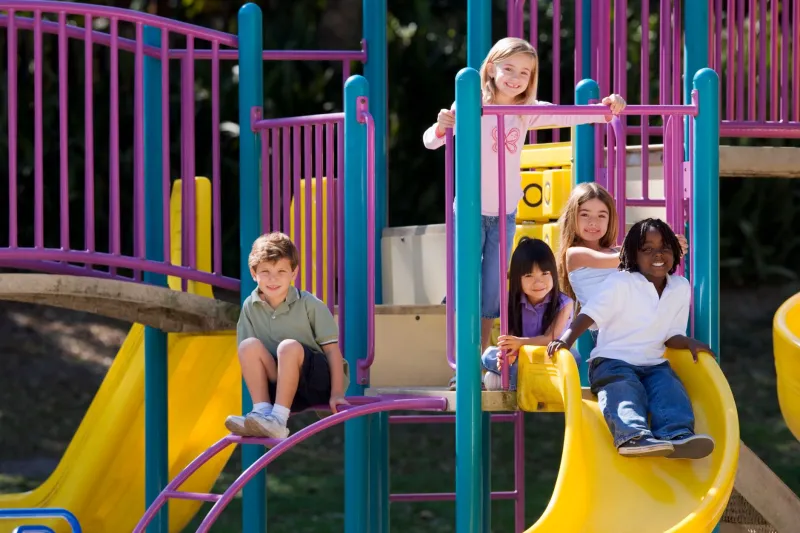
Picture a Saturday morning at your local park. Your five-year-old sizes up a group of kids already deep into an elaborate game of tag-with-rules-nobody-told-her. She hovers. She watches. Then she makes her move — maybe a well-timed joke, maybe just running alongside them until they give up and let her in.
What you're witnessing looks like nothing. It's actually a full-blown skills assessment in progress — and there's no adult refactoring the rules or smoothing the edges. As we like to say around here at Aspire Education Care, the playground might just be your child's first job interview, complete with rejection, negotiation, and teamwork under pressure.
The Skills Hiding in Plain Sight
Hiring managers love to talk about 'soft skills' — communication, adaptability, collaboration, emotional regulation. It turns out those exact competencies get forged on swings and monkey bars long before anyone fills out a W-2.
When researchers talk about executive function, they mean the brain's management system: working memory, self-control, and mental flexibility. Unstructured play with unfamiliar kids is basically executive function boot camp. Your child has to hold the new game's rules in her head, suppress the urge to grab the ball, and pivot instantly when the group changes the rules — which kids do constantly, and usually mid-play.
Now compare that to an adult job scenario: joining a new team, learning its unwritten norms, adapting when the project scope shifts. Sound familiar? The playground version just smells more like sunscreen.
Reading the Room, Four Feet Tall
Walk through what actually happens when a child tries to join a game with strangers:
- Observation. Before approaching, most kids watch from the sidelines, figuring out the social dynamics. That's not shyness — that's information gathering.
- Entry strategy. Some kids ask directly ('Can I play?'). Others contribute first — grabbing a wayward ball, mirroring the group's behavior. Both are legitimate social tactics adults use in meetings every day.
- Handling a 'no.' Getting turned away from the slide line or the sandbox kingdom stings. But it's also a low-stakes rehearsal for disappointment, with a built-in recovery: try again, find another group, or renegotiate the terms.
- Conflict resolution. No adult is hovering to adjudicate who was 'it' first. Kids either work it out or the game dissolves — a natural consequence that teaches faster than any lecture.
Every one of these moments is practice in reading social cues, managing emotions, and collaborating with people who don't share your history or your rules. In other words: the exact toolkit of a good coworker.
Why 'Unstructured' Is the Operative Word
Here's the part that's hard for us well-meaning parents: the magic mostly happens when we step back.
Enrichment classes, coached sports, and adult-directed playdates all have value. But they typically come with pre-set rules, adult supervision of every dispute, and a structure that does the heavy lifting. Free play with unfamiliar kids removes all those supports. The children have to build the game — and the social contract — from scratch.
That's why a chaotic, slightly chaotic-sounding Saturday at a busy playground can do developmental work that a tightly scheduled week of activities can't. It's not about filling every hour with 'productive' programming. It's about leaving space for the messy, self-directed negotiations where the real learning lives.
How to Support Without Orchestrating
So what's your role in all this? Think stage manager, not director.
1. Choose the venue, then zip it. Pick a park with a good mix of ages and kids, bring the snacks, and resist the urge to narrate. 'Go introduce yourself!' is less helpful than it feels. Hovering nearby silently sends the message that you trust them to figure it out.
2. Let the 'no' stand. If another child says your kid can't play, fight the instinct to intervene immediately. A brief moment of disappointment, followed by your child's own recovery, builds more resilience than any pep talk. Save your intervention for genuine bullying or safety issues.
3. Debrief later, not live. On the car ride home, a light question works wonders: 'What was the trickiest part of that game?' You'll often be surprised by how much social calculation went on in there.
4. Mix up the cast. Regular playdates with the same familiar friends are comfortable — but the growth spike comes from strangers. New kids at the park mean no established pecking order, no shared history, and no shortcuts. Every interaction has to be built fresh.
5. Model it yourself. Kids notice when you chat with another parent at the bench, handle an awkward moment gracefully, or bounce back from a brush-off. Your small social risks are a live demonstration of exactly what they're practicing.
Reframing What 'Productive' Play Looks Like
We live in a culture that loves measurable outcomes — letter sounds, counting to one hundred, sight word lists. Those matter. But the playground skills are quieter and harder to chart: the ability to join a group, absorb its norms, contribute something, recover from rejection, and keep playing.
Those aren't just nice-to-haves. Long-term research on childhood development consistently points to early social competence as one of the strongest predictors of adult wellbeing — stronger, in some studies, than early academic scores.
So the next time you're at the park and your kid gets shut out of the four-square game, take a breath before you swoop in. That stinging little moment is tuition for a skill set that will serve her for decades. The playground isn't a break from learning. It might be the most relevant curriculum she'll ever get — no flashcards required.